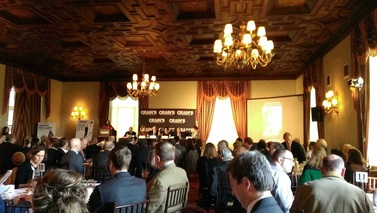
Can a table of five powerful preservation and development voices come to agreement regarding landmarking and development? Crain’s New York Business held a forum earlier this week - “Is Landmarking Out of Control?” to address the issues from a variety of perspectives.
LANDMARKING IS NOT THE ENEMY – Peg Breen
Peg Breen, President of the New York Landmarks Conservancy, emphasized that landmarking is not the enemy. Historic districts are important and landmarked buildings do contribute to affordable housing. Giving clarity to who should be making decisions about such things, Breen stated, “It shouldn’t just be the developers who have the say in whether a building should or shouldn’t be landmarked. Developers are not the only ones who invest in this city, we all do.”
Historic districts (which arose as an underlying development issue) are not, Breen emphasized, designated without the desire and agreement of the community, “the people who live here.” Viewing historic districts as pointless, Kenneth T. Jackson, Professor of History and Social Science of Columbia University, said that people are interested in individual buildings. He has never heard of anyone saying that they want to come to New York to visit a historic district.
LANDMARKING PROCESS NEEDS REFORM – Steven Spinola
The main mantra of Steven Spinola, President of the Real Estate Board of New York, was the process of landmarking which he felt was overly aggressive and out of control. His concerns were felt by all on the board: The process is in dire need of change. The changes needed include a specific time frame so that development is not stifled by a prolonged indefinite process, consideration of job creation, revenue, impact on the city itself, and affordable housing.
In an attack on Spinola’s view of landmarking, a question was posed regarding REBNY’s survey of 500 buildings for potential designation resulting in not one potential landmark. But Spinola allayed the concern by explaining that as the buildings were reviewed one by one, they were either substantially altered, had a problem with structural integrity, or poor copies of the real thing.
Steven Spinola’s concern about landmarking reached beyond the process to a concern for owners who were uninformed of the requirements of upkeep. What is needed are design guidelines which, he informed us all, he had been requesting for many years without any results. It is a major issue for owners and they should know what specific changes are permissible for their designated property.
AFFORDABLE HOUSING NOT NECESSARILY CAUSE & EFFECT – Ronda Wist
Ronda Wist, vice president of Municipal Art Society of New York, attacked the main question in a congenial venn diagram approach, explaining that there were many things that all panel members agreed upon while having their own opinion on some aspects. She agreed permits being held up at the 11th hour should not be the norm. Moving away from numbers of how many affordable housing units were here or there, Wist chose to focus on cause and effect. In her own neighborhood, which is not landmarked, there wasn’t a single affordable housing unit concluding that lack of affordable housing was not the effect of landmarking.
TOP 10 LARGEST BUILDINGS IN THE WORLD, NYC HAS ZERO – Kenneth T. Jackson
Kenneth T. Jackson, Professor of History and Social Science of Columbia University, had much to say about the detriments of landmarking. History, he claimed, is not about the buildings, it is about the people. “We need to expand our understanding of history.” Tossing out the idea of retaining old buildings, Jackson focused on affordable housing, progress and building “new.” “History is for losers,” he interjected at one point during the forum discussion.
He also noted that at one time New York City had 9 out of the 10 tallest buildings in the world; now we have zero. We are not building, what we have is too expensive, and we need more housing. If you want to live in a city, you need to expect change. This change should be decided by appealing to the 20-somethings who are around the country and want to move to New York.
A NEW GENERATION OF PRESERVATION & DEVELOPMENT - Nikolai Fedak
Nikolai Fedak, founder and editor of New York YIMBY (Yes In My Back Yard), was in agreement that we need to build, but current buildings are not meeting the needs of the coming generation of young business entrepreneurs. Fedak was the voice of this new generation. He was clear and concise, stating that the city is about dynamic change; we need good development, not prohibitive development. While some buildings need to be preserved he noted, “landmarking is being used as a political tool rather than a tool to preserve what needs preserving. Politicians parlay to their own ends.” The new tech generation of business entrepreneurs need small esthetically pleasing spaces that are built to provide what is needed. Clearly forward looking, his focus was on finding ways to negotiate without compromising one’s stand on preservation and development.
BOTTOM LINE
Toward the end, the floor was opened to attendees who seemed more bent on venting than asking questions. As the panelists gave their closing few words, it was clear that several issues were the concern of most: The city needs to progress; affordable housing needs to be included in all development, not just landmarked ones; the process of landmarking needs reform; landmarking needs to be a proactive process, not a reactive one; and it needs to be future thinking.
The best part of these events is having a moment to discuss issues one-on-one. I had the opportunity to speak with several panelists post-forum. It was clear that the wheels are turning on ideas of how to address the concerns voiced while integrating the needs of both preservation and development. As I stood outside the beautiful New York Athletic Club speaking with Nikolai Fedak, we agreed that the Hearst Tower on 57th is a great example of marrying the old with the new. “All buildings should be like that,” Fedak commented. And in response to my noting his very balanced view on preservation and development during the forum, he replied, “If we can’t come to an agreement, what is the point?”
Hear, hear!
LANDMARKING IS NOT THE ENEMY – Peg Breen
Peg Breen, President of the New York Landmarks Conservancy, emphasized that landmarking is not the enemy. Historic districts are important and landmarked buildings do contribute to affordable housing. Giving clarity to who should be making decisions about such things, Breen stated, “It shouldn’t just be the developers who have the say in whether a building should or shouldn’t be landmarked. Developers are not the only ones who invest in this city, we all do.”
Historic districts (which arose as an underlying development issue) are not, Breen emphasized, designated without the desire and agreement of the community, “the people who live here.” Viewing historic districts as pointless, Kenneth T. Jackson, Professor of History and Social Science of Columbia University, said that people are interested in individual buildings. He has never heard of anyone saying that they want to come to New York to visit a historic district.
LANDMARKING PROCESS NEEDS REFORM – Steven Spinola
The main mantra of Steven Spinola, President of the Real Estate Board of New York, was the process of landmarking which he felt was overly aggressive and out of control. His concerns were felt by all on the board: The process is in dire need of change. The changes needed include a specific time frame so that development is not stifled by a prolonged indefinite process, consideration of job creation, revenue, impact on the city itself, and affordable housing.
In an attack on Spinola’s view of landmarking, a question was posed regarding REBNY’s survey of 500 buildings for potential designation resulting in not one potential landmark. But Spinola allayed the concern by explaining that as the buildings were reviewed one by one, they were either substantially altered, had a problem with structural integrity, or poor copies of the real thing.
Steven Spinola’s concern about landmarking reached beyond the process to a concern for owners who were uninformed of the requirements of upkeep. What is needed are design guidelines which, he informed us all, he had been requesting for many years without any results. It is a major issue for owners and they should know what specific changes are permissible for their designated property.
AFFORDABLE HOUSING NOT NECESSARILY CAUSE & EFFECT – Ronda Wist
Ronda Wist, vice president of Municipal Art Society of New York, attacked the main question in a congenial venn diagram approach, explaining that there were many things that all panel members agreed upon while having their own opinion on some aspects. She agreed permits being held up at the 11th hour should not be the norm. Moving away from numbers of how many affordable housing units were here or there, Wist chose to focus on cause and effect. In her own neighborhood, which is not landmarked, there wasn’t a single affordable housing unit concluding that lack of affordable housing was not the effect of landmarking.
TOP 10 LARGEST BUILDINGS IN THE WORLD, NYC HAS ZERO – Kenneth T. Jackson
Kenneth T. Jackson, Professor of History and Social Science of Columbia University, had much to say about the detriments of landmarking. History, he claimed, is not about the buildings, it is about the people. “We need to expand our understanding of history.” Tossing out the idea of retaining old buildings, Jackson focused on affordable housing, progress and building “new.” “History is for losers,” he interjected at one point during the forum discussion.
He also noted that at one time New York City had 9 out of the 10 tallest buildings in the world; now we have zero. We are not building, what we have is too expensive, and we need more housing. If you want to live in a city, you need to expect change. This change should be decided by appealing to the 20-somethings who are around the country and want to move to New York.
A NEW GENERATION OF PRESERVATION & DEVELOPMENT - Nikolai Fedak
Nikolai Fedak, founder and editor of New York YIMBY (Yes In My Back Yard), was in agreement that we need to build, but current buildings are not meeting the needs of the coming generation of young business entrepreneurs. Fedak was the voice of this new generation. He was clear and concise, stating that the city is about dynamic change; we need good development, not prohibitive development. While some buildings need to be preserved he noted, “landmarking is being used as a political tool rather than a tool to preserve what needs preserving. Politicians parlay to their own ends.” The new tech generation of business entrepreneurs need small esthetically pleasing spaces that are built to provide what is needed. Clearly forward looking, his focus was on finding ways to negotiate without compromising one’s stand on preservation and development.
BOTTOM LINE
Toward the end, the floor was opened to attendees who seemed more bent on venting than asking questions. As the panelists gave their closing few words, it was clear that several issues were the concern of most: The city needs to progress; affordable housing needs to be included in all development, not just landmarked ones; the process of landmarking needs reform; landmarking needs to be a proactive process, not a reactive one; and it needs to be future thinking.
The best part of these events is having a moment to discuss issues one-on-one. I had the opportunity to speak with several panelists post-forum. It was clear that the wheels are turning on ideas of how to address the concerns voiced while integrating the needs of both preservation and development. As I stood outside the beautiful New York Athletic Club speaking with Nikolai Fedak, we agreed that the Hearst Tower on 57th is a great example of marrying the old with the new. “All buildings should be like that,” Fedak commented. And in response to my noting his very balanced view on preservation and development during the forum, he replied, “If we can’t come to an agreement, what is the point?”
Hear, hear!
 RSS Feed